
A founder's public identity becomes interesting when you can see how they work. A biography tells you where someone has been. A useful explanation shows you what they notice, how they make decisions, and what they can help you understand.
These five personal branding examples offer different ways of making that professional identity visible. Finn Mallery connects founder stories with a product people can try. Guillermo Rauch links technical arguments to working examples. Lara Acosta turns personal stories into useful teaching and resources. Arvid Kahl keeps a recognizable subject while reconsidering what to share. Paul Graham makes the development of an idea the central artifact.
For a freelancer, consultant, or founder, the useful question is what you could make similarly clear about your own work. Each case below follows the evidence into a practical exercise.
This is an editorial reading of selected public work, with links so you can examine the examples yourself. The screenshots record public pages on 16 and 17 October 2026; they are not endorsements by the people featured. Their experience, companies, and access to audiences are part of the context, and these examples do not establish that publishing caused their business results.
Jump to: Finn Mallery · Guillermo Rauch · Lara Acosta · Arvid Kahl · Paul Graham · Apply the examples
Finn Mallery: make the path to the product visible
Finn Mallery is Origami's founder and CEO; Y Combinator lists the company in its Fall 2024 batch. His communication often places a person, a practical task, and the product within the same account. That connection is worth examining because founder stories can otherwise leave a reader wondering what the company actually does.
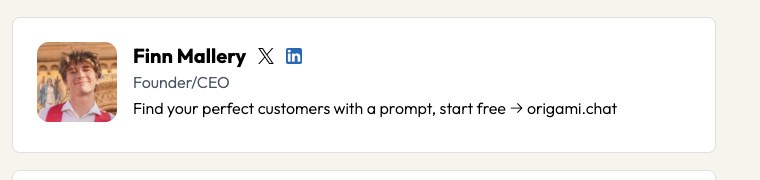
Consider his post about an early office setup. It starts with a place, introduces cofounder Kenson Chung, and describes coding, contacting prospective customers, and repeatedly rebuilding. It closes by offering access to what came out of that room.
The ending changes how the story functions. The office supplies a setting, the work supplies movement, and the invitation gives the reader a way to continue. A scene earns its place when it helps someone understand the professional activity behind the offer. You could use a similar connection with a workshop photograph, a project notebook, or an early prototype, provided the accompanying explanation shows what happened there.
His account of delivering early results through Google Sheets adds a useful complication. The opening describes building before having a product, then qualifies that framing: agents found the leads, while customers received spreadsheets because there was no frontend. The qualification makes the work more intelligible. It distinguishes the delivery experience from the underlying technology.
That is a useful editing lesson. When a dramatic opening requires clarification, make the clarification easy to find. A prospective customer needs enough detail to understand the service, including the parts that were manual or unfinished. The specific workflow carries information that a headline about entrepreneurial determination cannot.
In his product launch post, Mallery connects prior outbound-agency experience with a prompting workflow and several concrete prospecting use cases. The reader moves from his background to a task the product is meant to perform. Those examples make the intended audience easier to picture than an abstract promise about AI productivity.
The same directness appears in his hiring lessons: mistakes lead into process details, including telling candidates how a work trial will be evaluated. A guide invitation and product invitation follow. Teaching and promotion coexist visibly. You can inspect the transition without accepting every recommendation; the comments also contain objections to parts of the hiring approach.
Mallery's useful example is that connection between experience, explanation, and next step. Copying his slang or dramatic openings would leave the substantive work undone. His own ten-rule post warns about spending all one's time producing content. The communication needs something real to communicate.
Try this: Choose one moment from a recent project. Write what was difficult, what you did, and what someone can inspect now. Add a relevant next step, such as viewing the example or asking about the process. Check that the reader can describe your work after reading it.
Guillermo Rauch: let the work carry the point of view
Guillermo Rauch's biography identifies a software engineer and Vercel CEO, then links technical contributions including Socket.IO and his design and coauthorship of Next.js. The links give the professional description a second layer: a reader can move from the claim into the work.
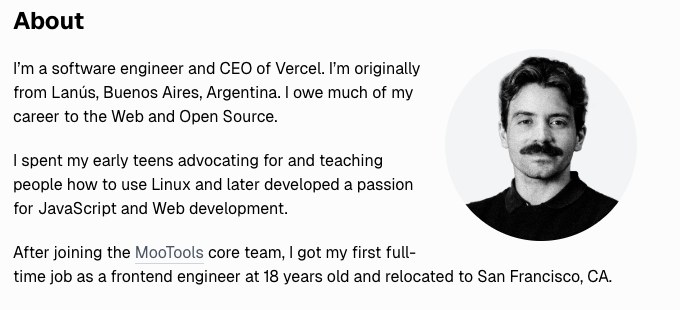
A portfolio becomes more informative when the reader can also see the question connecting its projects. Across Rauch's writing, one recurring concern is the relationship between the experience of building software and the experience of using it. That provides a more substantial thread than simply identifying him with a technology category.
His 2014 essay 7 Principles of Rich Web Applications examines architecture through effects a person experiences: how quickly information appears, how an interface responds, and what happens as data changes. The technical detail serves a recognizable purpose. It explains why implementation choices matter to someone beyond the engineer making them.
For a specialist communicating publicly, that relationship is valuable. Your audience may understand your tools while still needing help evaluating the trade-offs. Another reader may know only the frustrating experience those tools are meant to improve. Moving between those levels lets an explanation remain technically meaningful while giving a less technical reader a reason to care.
The 2020 essay Develop, Preview, Test makes the argument tangible. Rauch revisits testing advice in light of changed deployment infrastructure, then demonstrates a test on his own blog. He deliberately introduces a misspelling in his name so the check fails, before showing the correction.
That small choice gives the reader something more useful than a flawless demonstration. The failure makes the purpose of the check visible. It also creates a compact example whose result the reader can understand without first accepting the whole architectural argument. A specialist can often communicate expertise this way: choose a small, revealing test and explain why its result matters.
In Making the Web. Faster., he distinguishes the developer using a tool from the person using what that developer produces. This makes the audience relationship explicit. It is a useful question for any professional whose work passes through an intermediary: whose experience should ultimately guide the decision?
The subject evolves. In The AI Cloud, published in 2025, Rauch argues for infrastructure suited to agents and connects that thesis to earlier frustration with the complexity of building for the web. The forecast belongs to him. Its relevance here is how a newer argument relates to a longer-running professional concern.
His writing also advocates for his company. Vercel's products and collaborative engineering work are material context, and the contributions of a company cannot be assigned to one founder. The transferable practice is to make your reasoning and your contribution inspectable. A point of view becomes easier to assess when the reader can follow it into a specific example.
Try this: Select one recommendation you frequently make. Show a small example where someone can see why it matters. Explain the trade-off and identify both the person doing the work and the person affected by its output. Link to the artifact alongside your explanation.
Lara Acosta: turn a personal story into useful teaching
Lara Acosta is a Kleo cofounder, alongside Jake Ward and Cam Trew. Her public work connects personal accounts of learning and building with explanations for people developing their own LinkedIn presence. The distinctive connection is between the experience she describes, the lesson she teaches, and the resource she offers next.
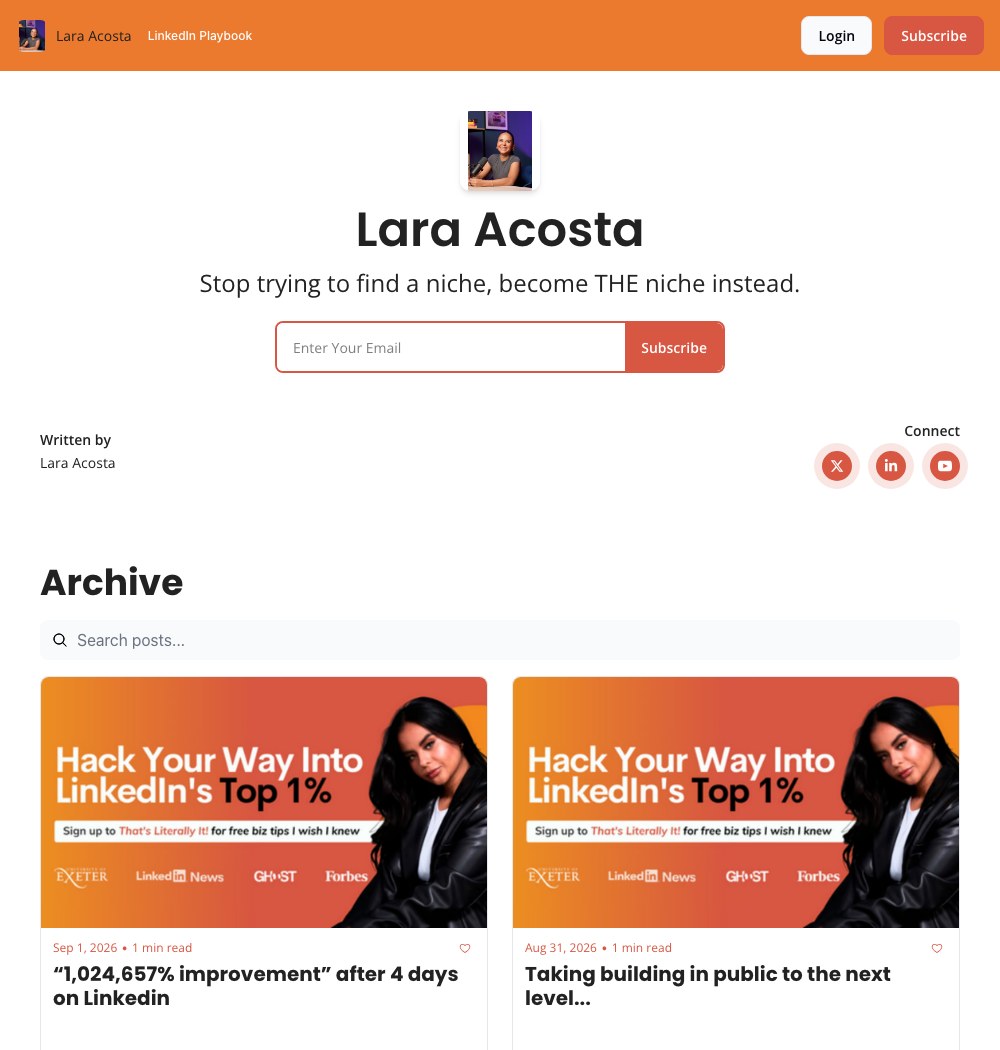
Her four-step storytelling post makes this relationship unusually explicit. She introduces a concern about telling personal stories, then describes a sequence: begin with experience, move into a lesson, offer practical advice, and invite the reader to respond. She names it the SLAY framework and ends with an invitation to learn more.
The interesting turn is where the author's experience becomes the reader's task. A story can explain why someone cares about a subject, but a useful lesson must also help another person think or act. Acosta makes that handoff visible. The post lets a prospective learner examine how she explains the work she teaches before deciding whether to continue.
That is a useful standard for a consultant or educator's public presence. Your own experience supplies context; the explanation shows what someone else can use. When editing a personal account, identify the point at which the reader receives something beyond information about you. A checklist, distinction, or worked example can make that contribution concrete.
In another post about having nothing to share, Acosta connects her student origin account with the hesitation she describes among learners. The personal material addresses a specific obstacle to beginning. Its usefulness depends on the explanation that follows, rather than on treating her experience as a result everyone can reproduce.
Her newsletter issue from 4 August 2024 extends the teaching into a resource. It starts with choosing an audience problem and explaining a solution, then uses a profile guide as an example that can appear in a carousel, PDF, and email. It also links to a masterclass.
The important continuity is the problem being addressed across formats. A reader should understand what a longer resource adds: perhaps more detail, an example to follow, or a tool to try. Repeating a personal introduction everywhere would provide less reason to make that next step. The invitation becomes clearer when the destination has a specific learning job.
There is also a necessary counterweight in her archive. In a May 2026 newsletter, Acosta criticizes businesses that depend on constant founder posting and personal availability, before inviting readers to an event about operations. The concern belongs beside her teaching about visibility. A recognizable public presence still requires decisions about workload and delivery.
Her posts and newsletters also promote products and events. Their strong promises are marketing claims, not evidence that a framework guarantees attention or clients. What you can inspect is the teaching sequence and the connection between its parts.
Try this: Take one event from your work and identify the question it helps a reader answer. Write the account, a lesson, and one action they can try. Then offer a longer resource only if you can explain what additional help it provides.
Arvid Kahl: keep the question, revise the boundary
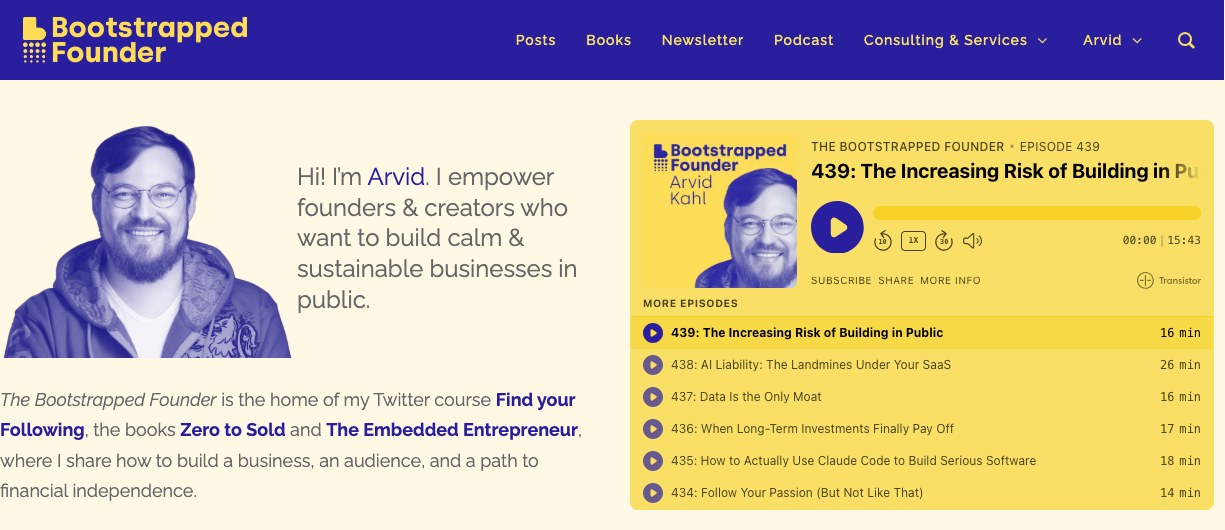
Arvid Kahl's biography identifies him as a FeedbackPanda cofounder alongside Danielle Simpson and explains his interest in helping self-funded founders. His publication makes that audience recognizable across several forms of work.
In his 2019 FeedbackPanda account, the starting point is Simpson's repetitive work writing feedback for language students. Kahl describes the tool they built and credits her community marketing. The account gives his later teaching a specific operational setting while preserving the contribution of his partner.
That detail matters when analyzing a founder's public identity. A personal account can explain someone's experience without absorbing everyone else's work into their reputation. Accurate attribution gives the reader a clearer understanding of what each person contributed.
In The Goals of Audience-Building, Kahl explicitly connects learning from a community with developing expertise and building something people need. The relationship is reciprocal: an audience provides information as well as receiving explanations. That is a useful lens for a professional who wants public communication to stay connected to actual problems.
The more interesting part of this case appears when his advice changes. In April 2026, The Increasing Risk of Building in Public argues that AI-enabled copying changes the risks of disclosure. Kahl describes tighter personal boundaries around numbers and architecture while leaving room for operational lessons. The argument is his assessment of the threat, rather than an established rule for every software business.
Read alone, that essay could suggest a simple story of abandoning transparency. His December 2021 essay on radical transparency complicates that reading. He was already defending founders' discretion and resisting demands to disclose everything. The later position changes the boundary within a longer discussion about what public sharing should require.
This is a richer model of professional consistency. You can keep addressing the same audience and recurring problem while explaining why a recommendation has become narrower. A reader should be able to follow the changed conditions. Treating every previous statement as a permanent commitment can make it harder to share useful learning.
His 2024 account of a failed Podscan refactor shows another kind of contribution: a deployment goes wrong, he rolls it back, and he explains the changes he would make to his planning and observability. The useful material is the reasoning produced by the setback. A polished success story would reveal a different, smaller part of the work.
The lesson has a practical boundary of its own. You can help someone understand a decision without exposing customer information, sensitive numbers, or the full implementation behind it. The choice of what to share belongs within your professional judgment. Public presence can include both generosity and discretion.
Try this: Describe one lesson from current work, one recommendation you have revised, and one category of information you keep private. Explain the reason for each. Check that a reader can understand the lesson without needing access to the protected detail.
Paul Graham: make the thinking an artifact
Paul Graham is a programmer, writer, investor, and Y Combinator cofounder. His essays offer a different kind of personal branding example: the public work lets a reader examine how a question develops into an argument.
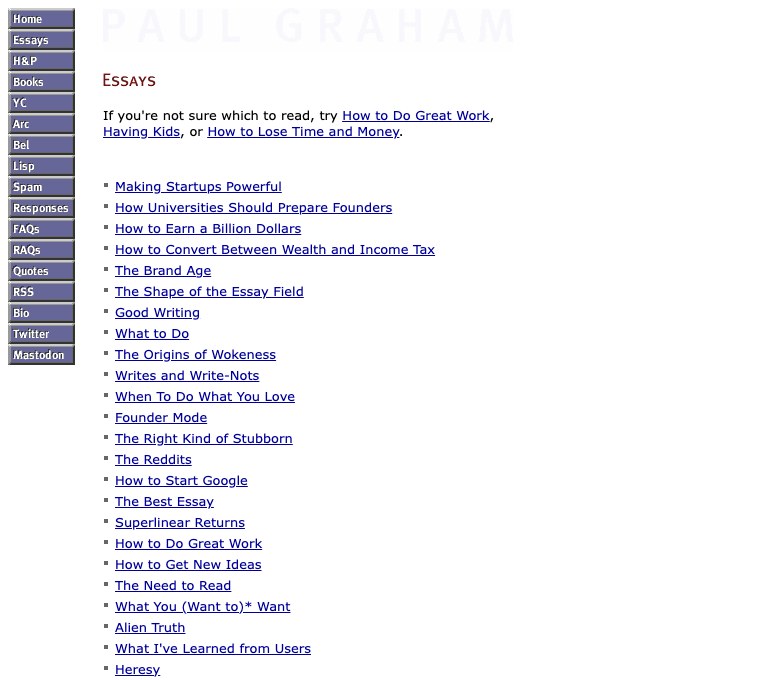
Take Maker's Schedule, Manager's Schedule, from July 2009. Graham distinguishes a day organized around appointments from work that needs longer uninterrupted periods. He then explains why a meeting can impose different costs on people using those schedules, and describes how he groups his own meetings.
The essay gives a reader a distinction that can be used in an ordinary professional conversation. Someone discussing a disrupted afternoon now has a way to describe the conflict more precisely. That usefulness depends on the explanation underneath the name: a label alone would leave the reader with little to apply.
It also shows why longform can matter to a professional identity. There is room to move from a familiar irritation into a model, explore its consequences, and show a response. Readers encounter the author's judgment through that movement. An essay can become a work sample for someone whose expertise involves analysis, strategy, or explaining complex situations.
Graham's writing about writing makes this interpretation more interesting. The Age of the Essay, published in 2004, describes an investigation that begins with a question and can change direction. Putting Ideas into Words, from 2022, describes formulation and repeated rereading as ways to discover gaps in an idea. Writing, in his account, changes the thought being expressed.
That creates room for a professional voice that develops through inquiry. You can become recognizable for the questions you pursue and the care of your reasoning while allowing the answer to change. An early draft can expose a weak distinction, an omitted condition, or an example that contradicts the appealing claim. Working through those problems is part of the substance a finished piece can offer.
Founder Mode, from September 2024, illustrates both the attraction and the risk of a named concept. It starts from Brian Chesky's talk, proposes a distinction, and acknowledges unresolved questions and possible misuse. The originating contribution belongs in the account, and the proposed model remains open to examination.
For a reader developing their own ideas, this is a useful discipline: preserve the observation, name the distinction only if it helps, and show where the explanation is incomplete. Clear language can carry a strong position together with its conditions. You do not need to turn every uncertainty into a vague disclaimer, but you do need to identify the uncertainty that changes the claim.
Graham's history and network are substantial context. Publishing essays cannot reproduce those advantages. What you can practice is making a piece of reasoning useful enough that another person can inspect it, challenge it, or apply it to a problem.
Try this: Start with a recurring question from your work. Develop one distinction that helps answer it, then test it against a counterexample. Revise the explanation for a reader who lacks your background. Give the idea a name only if the name makes the reasoning easier to use.
What changes across these personal branding examples
The cases share a connection between professional work and public explanation. Their strongest evidence takes different forms. Use the comparison to choose something appropriate to your work and audience.
| Person | What the reader can examine | A useful practice to adapt |
|---|---|---|
| Finn Mallery | The path from founder experience to a product task | Connect a specific story to an inspectable next step |
| Guillermo Rauch | A technical position demonstrated through work | Explain the trade-off and show a revealing example |
| Lara Acosta | A personal account connected to teaching and a resource | Give the reader a lesson and a clear next learning step |
| Arvid Kahl | A continuing subject with revised disclosure boundaries | Explain what changed and what remains useful to share |
| Paul Graham | A question developed into a usable argument | Test a distinction and make the reasoning readable |
A story, demonstration, teaching resource, operating lesson, and essay ask for different kinds of attention. A prospective customer may need to understand a task quickly. A fellow specialist may want the reasoning behind a recommendation. Someone learning a new skill may need a worked example they can follow at their own pace.
The format should help that reader do something. Before choosing a channel or cadence, identify the question the artifact needs to answer. This also gives you a more useful editing standard: does the piece let someone understand your contribution?
Notice, too, that continuity can sit at different levels. It may live in a recurring audience, a question, a professional concern, or a way of examining problems. Individual opinions and methods can change. When explaining a change, identify the new information and its practical consequence so a reader can follow your judgment over time.
Turn the examples into your own professional evidence
Begin with a small collection from work you have actually done: a decision, a useful artifact, and a question you keep returning to. For each, describe the person it helps and what becomes easier to understand when you explain it.
Then choose one piece to develop. A consultant could annotate a decision framework. A designer could explain a rejected direction and the constraint behind it. A developer could demonstrate a failure a check catches. These are possible exercises, not accounts of the founders above or guarantees of a commercial result.
Write a short explanation that includes the situation, your contribution, and the limits of the example. Credit collaborators. Remove claims that the artifact cannot support. Decide what can be shared safely, and provide enough context for someone outside the project to follow it.
Finally, connect that explanation to your professional introduction. Your personal brand statement should give the reader a useful orientation to the work they can inspect. If the introduction promises one thing and the examples show another, revise the language or choose better evidence. Our personal branding guide provides a broader starting point for clarifying that relationship.
You can develop your next piece by returning to a real question, making one contribution visible, and helping the reader understand what follows from it. Over time, that gives people something concrete to recognize in your work.